
UK Solar Industry 2025
The UK’s solar energy market size is pegged at 23 GW as of 2025, and is projected to reach 60 GW by 2030, growing at a CAGR of 23.5%. The Solar Industry Outlook 2025 for the UK can be summarized by following trends : a increase in PV sales, rise in the size and number of solar farms, and positive spillovers on the real estate sector through solar adoption.
With a solar market expected to touch £ 24 billion by 20230, the UK is emerging as a significant solr power in Europe, after Germany, Italy, Spain, and France.
This article is an analysis of UK’s Solar Power Industry Outlook 2025, wherein we will learn about the potential, trends, prospects, growth challenges, etc.,
You might also like:
10 Best Solar Panel Companies UK
UK Solar Industry Outlook 2025
UK’s Solar Power Industry – Current State
Currently, solar power accounted for only about 6.8% of the UK’s energy mix in the last quarter of 2023, according to government reports. However, there has been a gradual and steady increase in this direction with a reported increase of 6.6% in the UK’s solar capacity and a generation of 15.7 GW in January 2024. With the Government’s inclination towards the Net-Zero target(of greenhouse emissions) by 2050 and earlier targets set for 2035, solar power capacity is estimated to increase to about 43 GW by 2028.
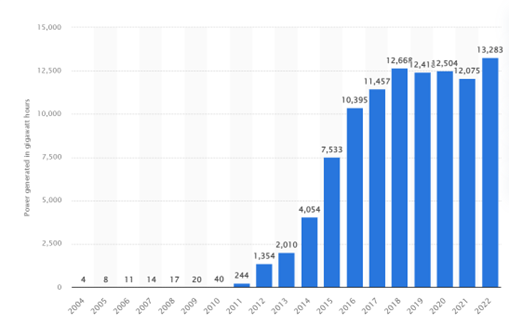
Generation of electricity through solar photovoltaic power (in GW) throughout the years in the UK(Source: statista.com)
Important to note that the Solar Power industry in the UK is largely driven by PV panel-based power generation, which can be divided into Residential, Commercial, and Industrial requirements across the country.
UK Solar Power – Categories and Prospects
- Residential Solar Installations:
These represent the bulk of PV installations in the UK, owing to increasing electricity prices, advancements in technology, Government subsidies in the form of Feed-in-Tariffs, etc., As of February 2024, the number of solar panel installations across the UK was around 1,468,652, and out of this residential buildings accounted for 83% of the new systems that were installed. The highest number of residential installations were found in some cities to the South-west of England like Plymouth(with 115,700 household installations) and Bristol(89,400) installations. [1]
- Commercial Solar Installations:
Commercial installations continue to grow in urban areas with large rooftop spaces. They are particularly high in number in cities like London and Bristol which abound in businesses that have installed PV panels. This growth has mainly been driven by the UK’s commitment to sustainability and the availability of large rooftop spaces. Some major cities with subsequent number of installations are given in the table below-
City | No. of Commercial solar installations |
London | 8,210 |
Birmingham | 6,920 |
Manchester | 6,410 |
Liverpool | 5,622 |
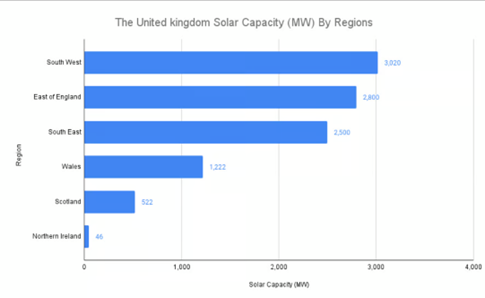
- Large-scale installations and solar farms: One of the major factors that has driven the growth of large-scale electricity generation through solar power in the UK is the high price of energy in the local market which has almost tripled since 2000. Solar farms can cover an area ranging from 1 to 100 acres, the distribution of solar farms across the UK is not uniform, the South Western region, having the largest potential for solar capacity, abounds in solar farms, which usually have ground-mounted panels. The largest solar farm in the UK is located in Oxfordshire and is capable of powering 14,000 homes!
UK’s “Solar Hotspots”
Regions in the UK are given a ‘Hotspot’ score based on their solar capacity and the number of solar installations. These are subject to various factors like-
- Average annual sunshine hours:
This influences the energy output and efficiency of the Solar Panels
- Percentage of households with solar installations
Higher percentages signify the rate of adoption of solar power in a particular region
- Installed capacity(in kWh):
Reflective of the total energy generation potential.
Based on the following factors, the UK cities with the highest proportion of solar installations include:
- Peterborough
- South Cambridgeshire
- Cornwall
- Winchester
- South Hams
UK Solar Industry Market Analysis (2024-29):
- Market size: The size of the UK’s solar power market is expected to stand around 23 GW by the end of 2025 and is expected to grow to 53.12 GW by 2029. Supportive Government policies and demand for renewable energy are the forces driving the market.
- Market trend: In May 2023, with 1,334,453 installations the UK recorded the highest annual increase in solar capacity since December 2017. In the residential sector, the most commonly installed solar system is one with a capacity of 4kW, suited to satisfy the energy needs of a household with 3-4 people. The energy crisis leading to a marked increase in energy prices in the domestic market prompted many homeowners to shift to solar power for their household energy needs and solar module orders increased between 2021-2022.
Another major factor driving the market has been the declining cost of Small-scale PV systems over the past few years. The average cost of the equipment, installation, and connection of small systems(between 0kW and 4kW) declined markedly in the last decade. Large-scale installations are deployed for commercial and industrial purposes and include systems between the capacities of 50kW and 5kW.
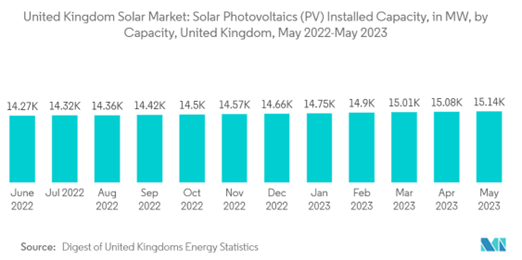
- Major Players:
The Solar power market in the UK is not very fragmented and is dominated by 4-5 major players which include-
- Electricite de France SA
- Lightsource BP Renewable Energy Investments Ltd.
- Hive Energy
- Renewable Energy Systems Ltd.
- Ecotricity Group Ltd.
UK Solar power Industry- Prospects
- Technological advancements:
Advancements in solar technology have come a long way and are driving energy efficiency and cost reductions. The latest technology like bifacial and backtracking panels can increase energy yield up to 20% more than usual. Recently, an Oxford-based firm has developed a technology that would allow an increase of up to 28% in energy efficiency, which can be viewed as a considerable leap.
- Community solar farms in the UK:
Community farms offer several economic, social, and environmental benefits by allowing local communities to invest in and reap the benefits of renewable energy resources. The trend has been on the rise in the UK with five community groups collaborating to buy seven solar farms in England and Wales, thus increasing the community-owned solar capacity by almost 20% The UK is also home to the Westmill Solar Co-operative which is the largest community-owned solar farm in the world, located in Oxfordshire.
- Government Support:
The Government has been thoroughly supportive in driving the increase in solar capacity, with its aim to increase the UK’s solar capacity five-fold to 70 GW by 2035. The Government has offered its support in the form of subsidies like Feed-in-Tariffs, approving large construction projects, establishing an Energy Saving Trust that monitors government grants for domestic photovoltaic systems, and programs like the ‘Green Energy for Schools’ program that intended to provide 100 schools across the UK with solar panels.
- Integration of Energy Storage:
Integration of energy storage systems, which are capable of storing the excess energy generated during the day for use at the times when the sun is not shining with the power-generating PV panels, has been gaining traction in the UK. As the cost of battery storage technologies continues to decline, solar-plus-storage systems are becoming more economically viable and attractive to consumers. This signifies a shift towards a more reliable and flexible solar power infrastructure, encouraging individuals and communities to choose this green energy source over traditional energy grid systems.
UK Solar Power Industry-Challenges
- Intermittent nature of Solar Energy: While Solar Panels generate electricity during daylight, the peak hours of demand are during the evening, which would require either efficient storage options or excellent grid export. However, the current capacity of the national grid to handle the exports and fluctuations remains limited, especially in areas with a high concentration of solar installations.
- Land Use and Planning: Reports by NextEnergy state that solar panels cover just 0.1% of the land in the UK, whereas a coverage of 0.3% is required to meet the government’s goal of a solar capacity of 70 GW by 2035. The challenges to the expansion of solar power infrastructure include regulations surrounding land use and planning, which due to a limited area is often in conflict with other land uses such as agriculture and housing. The effects of solar infrastructure on wildlife and local communities also has to be kept in mind.
- Solar skill gap: An obstacle to the solar industry reaching its full potential is the UK’s solar skill gap. An estimated 60,000 people are needed throughout the UK to fulfill the demand of the solar industry including 6,000 engineers annually. However, a lack of investment in training and education programs and general disinterest and unawareness of the solar power industry act as an impediment to its development.
UK Solar Sector – The road ahead
The Solar Power industry in the UK is beset with both successes and shortcomings, as it continues to move forward. Government support driven by their targets and commitment to decarbonization, innovations, increasing demand, and collaborative efforts of communities and businesses are set to play a vital role in making solar power pivotal to the UK’s energy mix, thus promoting a greener and more sustainable future.
Frequently Asked Questions
The China solar power industry remains the largest in the world with a solar power capacity of 790 GW(2024)
The UK’s solar market is expected to reach 25 GW in 2025.
Community Solar Projects allow individuals and organizations to invest their resources and reap the benefits of shared solar projects. The Westmill Solar Co-operative in Oxfordshire, UK is one of the world’s largest community-based solar farms.
Yes it is a misconception, Thus the idea that solar farms could bring about wind patterns is not true according to certain studies.
Solar farms reduce climate change and greenhouse gas emissions by providing clean energy which helps in reducing climate change and contributes to long-term stability.